


Select A Store
Select Store
My Store:
Select A Store
Overview
Overview
A Most-Anticipated Book of the Year: O, The Oprah Magazine * The New York Times * The Washington Post *Vogue * Bustle * BuzzFeed * Ms. magazine * The Millions * Huffington Post * PopSugar * The Lily * Goodreads * Library Journal * LitHub * Electric Literature
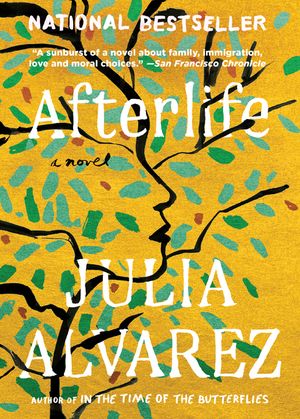
The first adult novel in almost fifteen years by the internationally bestselling author of In the Time of the Butterflies and How the Garc a Girls Lost Their Accents "A stunning work of art that reminds readers Alvarez is, and always has been, in a class of her own." --Elizabeth Acevedo, National Book Award-winning author of the New York Times bestseller The Poet X Antonia Vega, the immigrant writer at the center of Afterlife, has had the rug pulled out from under her. She has just retired from the college where she taught English when her beloved husband, Sam, suddenly dies. And then more jolts: her bighearted but unstable sister disappears, and Antonia returns home one evening to find a pregnant, undocumented teenager on her doorstep. Antonia has always sought direction in the literature she loves--lines from her favorite authors play in her head like a soundtrack--but now she finds that the world demands more of her than words. Afterlife is a compact, nimble, and sharply droll novel. Set in this political moment of tribalism and distrust, it asks: What do we owe those in crisis in our families, including--maybe especially--members of our human family? How do we live in a broken world without losing faith in one another or ourselves? And how do we stay true to those glorious souls we have lost?- Format: TradePaperback
- Author: Alvarez, Julia
- ISBN: 9781643751368
- Condition: Used
- Dimensions: 7.00 x 0.80
- Number Of Pages: 288
- Publication Year: 2021
Customer Reviews
Rating Snapshot
5 ★
100%
4 ★
0%
3 ★
0%
2 ★
0%
1 ★
0%
1 Ratings
0
0% Would Recommend
0 Recommendations
Review Images
Sort by:
-
“We will see what love can do.” #BannedBook
Jennifer N. - 5 years 8 months agoMental illness, immigration, immortality woven and spun into the tapestry of “a Latina sisterhood. Conflict is their modus operandi. Comparing, competing, bickering, issuing epithets, condescending ringtones, you name it, and at the same time, utterly loyal and bound to each other.” These are the strands from which Julia Alvarez’ Afterlife is spun. While attempting to rescue their eldest sister with her runaway mind and larger than life spirit, Antonia encounters a pregnant Mexican immigrant on her doorstep leading her to ask a series of philosophical questions: Who do we ask for help when we’ve run out of options? And what do we owe those who ask us? Why do we feel aggrieved when suffering strikes us? And does suffering hurt less if you’re poor? Is there an expiration date on the tendrils of a gratitude after the mother root expires? And can such empathy be a pathology? What, if anything does it mean? An afterlife? An afterlife is not self-care, “the mantra of the First World...The height of self care: the divinized self..Deserve...The verb annoys her--the whole idea that you are entitled to special treatment, a sense of grievance when life doles out to you what it doles out to everybody: mortality, sorrow, loss.” Self-care “smacks of a privileged mindset that believes itself exempt from the ills the rest of the world has to contend with...Everyone barricaded against the suffering of others, hoarding their investment in their own privatized versions of reality, giving their indifference the spin they needed in order to live exonerated.” And yet, “Even though she disapproves of the attitude, Antonia finds herself partaking of that same privileged prerogative.” Bottom line, we’ve not wanted to be our brother/sister’s keeper. We assert that “Living your own life is a full-time job...It’s nobody’s fault. Or everybody’s fault.” In the end, Antonia determines, “The best thing you can give the people you love is to take care of yourself so you don’t become a burden on them...the second best thing: to disappear altogether from the isolation of self-care. Instead, Alvarez presents compassion as an antidote to self-care. “Outsourcing compassion…conveniently removing herself from the havoc that the troubled cause in the lives of others...Since when is it okay to outsource basic human presence?...Assigned roles [are] part and parcel of being connected to others whom you have to discriminate a self from.” We define ourselves by being what the others are not and shoving them down our “othering chute.” “Even the beauties of language, of words rightly chosen, are riddled with who we are, class and race, and whatever else will keep us--so we think--safe on the narrow path and watch their dramas play out on the other side of the screen. “It isn’t a telenovela to the people it happens to. Another way to dismiss their plight. Ratchet it down a notch...Instead of the old conquistadors and missionaries, the rescuers are now well-meaning NGOs, Peace Corps volunteers, and development workers who come in with aid and answers. Another kind of conquest...Mario, Estela, Jose--they are all residents of dragon country, no man’s land beyond the gated communities of belonging [in] the magical theme park that is the First World to the migrant, the refugee, the wretched refuse from other teeming shores, until the discovery that admission to the magic show is denied them.” But that's the difference between statistics and story: “The great injustice of circumstance” versus “We will see what love can do.” Perhaps, love is after all, “a form of immortality.” #BannedBook