


Select A Store
Select Store
My Store:
Select A Store
Overview
Overview
"An eerily prescient novel about a devastating virus that begins in Asia before going global . . . A page-turner that has the earmarks of an instant bestseller." --New York Post
"Featuring accounts of past plagues and pandemics, descriptions of pathogens and how they work, and dark notes about global warming, the book produces deep shudders . . . A disturbing, eerily timed novel." --Kirkus Reviews
"A compelling read up to the last sentence. Wright has come up with a story worthy of Michael Crichton. In an eerily calm, matter-of-fact way, and backed by meticulous research, he imagines what the world would actually be like in the grip of a devastating new virus." --Richard Preston, author of The Hot Zone "This timely literary page-turner shows Wright is on a par with the best writers in the genre." --Publishers Weekly (starred review) In this riveting medical thriller--from the Pulitzer Prize winner and best-selling author--Dr. Henry Parsons, an unlikely but appealing hero, races to find the origins and cure of a mysterious new killer virus as it brings the world to its knees. At an internment camp in Indonesia, forty-seven people are pronounced dead with acute hemorrhagic fever. When Henry Parsons--microbiologist, epidemiologist--travels there on behalf of the World Health Organization to investigate, what he finds will soon have staggering repercussions across the globe: an infected man is on his way to join the millions of worshippers in the annual Hajj to Mecca. Now, Henry joins forces with a Saudi prince and doctor in an attempt to quarantine the entire host of pilgrims in the holy city . . . A Russian migr , a woman who has risen to deputy director of U.S. Homeland Security, scrambles to mount a response to what may be an act of biowarfare . . . Already-fraying global relations begin to snap, one by one, in the face of a pandemic . . . Henry's wife, Jill, and their children face diminishing odds of survival in Atlanta . . . And the disease slashes across the United States, dismantling institutions--scientific, religious, governmental--and decimating the population. As packed with suspense as it is with the fascinating history of viral diseases, Lawrence Wright has given us a full-tilt, electrifying, one-of-a-kind thriller.
"Featuring accounts of past plagues and pandemics, descriptions of pathogens and how they work, and dark notes about global warming, the book produces deep shudders . . . A disturbing, eerily timed novel." --Kirkus Reviews
"A compelling read up to the last sentence. Wright has come up with a story worthy of Michael Crichton. In an eerily calm, matter-of-fact way, and backed by meticulous research, he imagines what the world would actually be like in the grip of a devastating new virus." --Richard Preston, author of The Hot Zone "This timely literary page-turner shows Wright is on a par with the best writers in the genre." --Publishers Weekly (starred review) In this riveting medical thriller--from the Pulitzer Prize winner and best-selling author--Dr. Henry Parsons, an unlikely but appealing hero, races to find the origins and cure of a mysterious new killer virus as it brings the world to its knees. At an internment camp in Indonesia, forty-seven people are pronounced dead with acute hemorrhagic fever. When Henry Parsons--microbiologist, epidemiologist--travels there on behalf of the World Health Organization to investigate, what he finds will soon have staggering repercussions across the globe: an infected man is on his way to join the millions of worshippers in the annual Hajj to Mecca. Now, Henry joins forces with a Saudi prince and doctor in an attempt to quarantine the entire host of pilgrims in the holy city . . . A Russian migr , a woman who has risen to deputy director of U.S. Homeland Security, scrambles to mount a response to what may be an act of biowarfare . . . Already-fraying global relations begin to snap, one by one, in the face of a pandemic . . . Henry's wife, Jill, and their children face diminishing odds of survival in Atlanta . . . And the disease slashes across the United States, dismantling institutions--scientific, religious, governmental--and decimating the population. As packed with suspense as it is with the fascinating history of viral diseases, Lawrence Wright has given us a full-tilt, electrifying, one-of-a-kind thriller.
- Format: TradePaperback
- Author: Wright, Lawrence
- ISBN: 9780593081143
- Condition: Used
- Dimensions: 8.00 x 0.90
- Number Of Pages: 400
- Publication Year: 2021
Customer Reviews
Rating Snapshot
5 ★
33%
4 ★
50%
3 ★
17%
2 ★
0%
1 ★
0%
6 Ratings
0
0% Would Recommend
0 Recommendations
Review Images
Sort by:
-
The End of October is a prescient and eerily prophetic thriller. #SummerReading
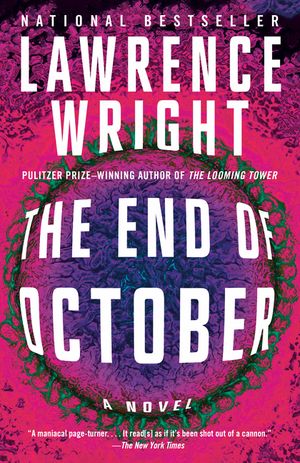
Jennifer N. - 5 years 11 months agoAll things holiday are unleashed at The End of October and the cover of Lawrence Wright’s novel is no exception. It depicts “a spiky round ball, tinted in red and green, looking like a Christmas ornament. October Revolution Island was also an outpost of the Soviet biochemical warfare program. ‘When you say “flu,” this is what we’re dealing with… an almost instant global pandemic of the most lethal influenza we’ve ever seen.” Along with festivities, flu session typically begins At the End of October, thus the title of this best selling and eerily prophetic thriller. In addition to its influence on science and politics, Wright addresses the impact of influence of the flu on faith. In this case, the pilgrims in Mecca must be quarantined. Is this a curse on Islam? An attack on Saudi Arabia? A spiritual conspiracy to confiscate the holy places? Meanwhile, Henry is compelled to grapple with his Christian experience. Raised by Hungarian grandparents, one of the two things his grandfather imparted to Henry was his hatred of religion. Henry’s parents had been missionaries in South America, too busy saving the world to care for their son and perished from drinking cyanide when he was four years old. Henry’s wife Jill “supposed that was why Henry had such strong opinions about the dangers of religion...religion seemed to be one of the few things Henry actually feared. Science was his way of protecting himself from the lure of belief.” And so he joins the cult of science, using human intelligence to save the world from itself. And yet although he is an atheist, one of Henry’s heroes is Lutheran missionary Albert Schweitzer. Schweitzer’s beliefs were undergirded by the following tenets: ethics is Reverence for Life; morality consists in maintaining, assisting and enhancing life; and evil is destroying, harming, or hindering life. To disgrace one’s religion is to spit on his soul. “Religion of any sort aroused intense feelings in him that were difficult to categorize. He felt contempt. He felt fear. He felt curiosity.… similar to his aversion to heights…an inner compulsion that frightened him...Another emotion that sometimes clouded his thinking where religion was concerned was envy. How pleasant to believe that a force outside of one’s self cared about human events, a force that could influence the outcome of a dilemma such as this one – if only a person prayed hard enough and persuasively enough to capture the divinity’s attention...Instead of praying, he reflected on all that he had done wrong.” Henry is “shocked that the thought of praying had leapt into his mind.” Instinctively, we know that in our weakness, He proves His strength. Although his concept of religion is frayed, the theme of the longing for prayer ribbons throughout. During one of their last conversations, Majid says, “On the one hand, you suggest that the blessings you receive you did not earn, and on the other, you believe that you are responsible for everything bad that happens. This is a very Islamic attitude.” And yet isn’t it a Christian attitude as well? Something we are perpetually striving to simultaneously live out and overcome? As Christians we believe not that our goodness comes from our belief but from its Source. Religion causes good people to do evil, a relationship with God through Jesus is to discover the source of truth and goodness. “We all imagine that we have strong moral bearings, but those same instincts that lead us to do good in the world may be bent toward the vilest actions.” God “saw the wound in you that you cannot heal” and He sent His Son to be wounded for your transgressions! The End of October is not only Henry's quest for a cure to a physical pandemic but his spiritual journey. ‘There’s a secret inside I’ll never unlock. If I could open that door, maybe I would find something like a soul.’” But perhaps the door opens from the other side from the Great Unknowable. As a Christian I agree with his assertion that we are made in the image of God, “but there’s a piece of genetic code inside us that wants to blow it all to pieces.” That code is called sin. Instead of a believer, Henry sees himself as a deceiver, “as if the lie would chase away the truth.” “Faced with death, he realized his selfishness, his inadequacy. He only wanted…to be redeemed...He had come to the end of his resistance, or even his reason...Henry knew that salvation would never be his.” Henry fails to see that his disease turned out to be his salvation and that his curse carried a blessing inside it, that his family was spared from attack from bears during their camping trip, his submarine’s rescue from Russian attack by snapping shrimp. The fingerprints of the Author of creation are all over this hard-boiled atheist! #SummerReading
-
Ok
Bill P. - 6 years agoAlmost like reading the newspaper. Very interesting facts considering the current pandemic.
-
The End of October
Thomas G. - 6 years agoGood information but not so good character development.
-
Excellent pandemic thriller
Ashleigh P. - 6 years agoWow. This book was meant to be a summer thriller with a warning. Instead it feels like prophecy. The author did extensive research for years, and wrote it before COVID 19 was even known. And yet here we are, living this dystopia. Trigger warnings abound and if viruses and biologic warfare and lots of death are not your thing, but this is a fantastic read for the current time. #summerreading
-
Disappointing
Ruth N. - 6 years agoThe first part of the book was intriguing and kept me interested. That was the part about the mystery of a new virus. However, from there it went into too many tangents—quarantine in Saudi Arabia, months on a submarine, and every so often information about his desperate family back home. It was too disjointed and a big disappointment.